How Market Forces and Trade Wars Are Undermining Global Antibiotic Access
Access denied? When markets decide who gets antibiotics
Von Nadya Wells
Fleming’s accidental discovery of penicillin in 1928 heralded one of medicine’s greatest revolutions. The subsequent golden era of antibiotic discovery transformed treatment of previously fatal infections, enabling decades of safe surgery, and advances in immunosuppressive cancer care. However, emerging antibiotic resistance threatens to undo decades of medical progress rendering our existing medicines ineffective. Confronting this growing risk requires access to the right antibiotics at the right time, yet most major pharmaceutical companies have abandoned antibiotic research and production. Innovation now relies on financially fragile biotech companies while low profit margins are driving shortages of essential generic antibiotics. As a result, the entire antibiotic investment ecosystem is being reshaped by market logics that determine which antibiotics survive, which supply chains remain viable, and ultimately who gets access to life saving treatment. An additional emerging risk of disruption to global antibiotic infrastructure is being driven by contemporary pharmaceutical trade wars.
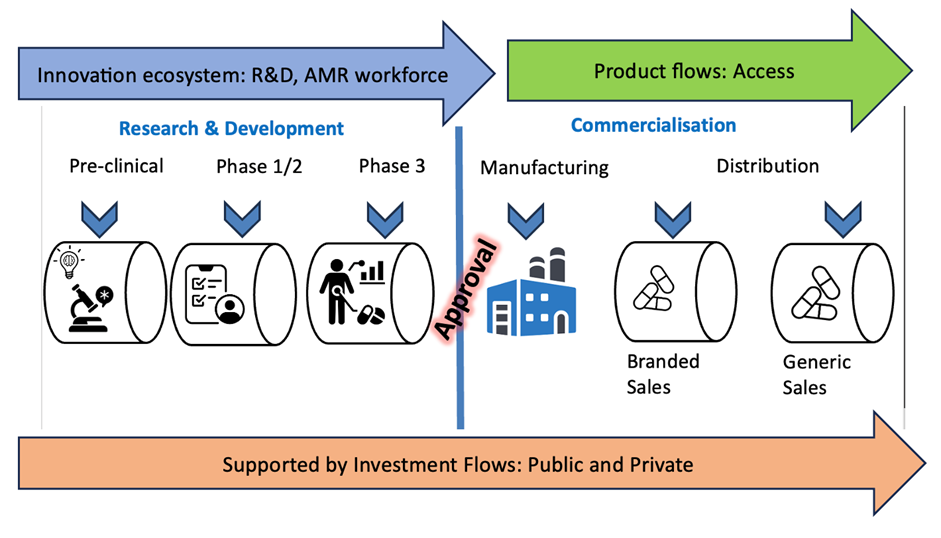
Access to antibiotics is conventionally determined by the innovation and supply infrastructure of pharmaceutical trade supported by public and private investment flows.
Access to antibiotics is conventionally determined by the innovation and supply infrastructure of pharmaceutical trade supported by public and private investment flows (see Figure 1).
Figure 1: Antibiotic Infrastructure (Wells, 2024)
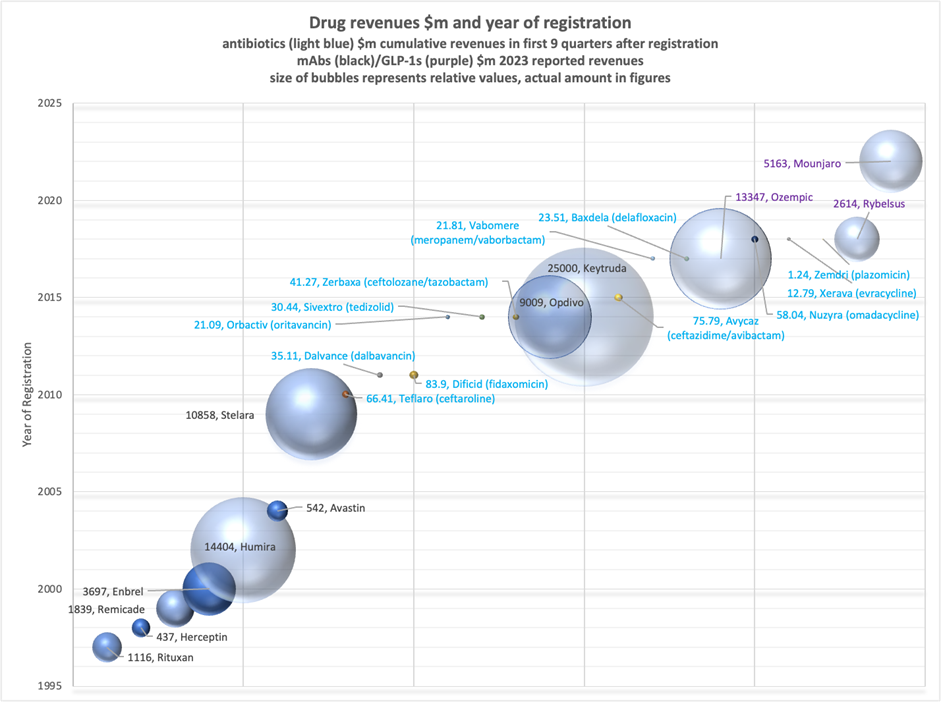
However, today this infrastructure is crumbling driven by financial market forces which have seen many pharmaceutical firms pull out of antibiotic R&D and production altogether. The opportunity cost for a firm investing in a small potential revenue stream from new antibiotics is considerable. Low potential antibiotic revenues stand in contrast to the large revenue streams from blockbuster non-communicable disease drugs such as monoclonal antibodies for cancer treatment. Today the obesity market alone is projected to reach $100bn by 2030 in a so-called ‘new era of mega blockbusters’ driven by semaglutides (Khalil and Kazimi 2024) (see Figure 2 below). Low potential revenues from antibiotic innovation fail to compete with the large revenue streams from blockbuster non-communicable disease drugs.
Figure 2: The opportunity cost of antibiotic innovation for drug developers (Wells et al. 2025)
Meanwhile, an inability to prescribe the right antibiotic, in the right dose, at the right time allows antimicrobial resistance (AMR) to accelerate and spread(Baraldi et al. 2024; Pandey et al. 2024; WHO 2023). The most recent Lancet study of the global health burden of resistant infections evidenced 4.71 million AMR-related deaths in 2021 while forecasting 92 million future deaths could be averted (2025-2050) given better care of severe infections, and improved antibiotic access(Naghavi et al. 2024). Indeed, the Geneva-based Global Antibiotic Research and Development Partnership (GARDP) states access can mean the difference between life and death for a patient with a serious bacterial infection(GARDP 2024).
Commercial determinants of antibiotic innovation and access
Returns on investment in innovation and commercialisation of novel antibiotics have failed to compete with more profitable therapeutic areas (Serra-Burriel et al. 2023; Paton and Kresge 2018). The need for conservative use to protect these vital new agents from emerging resistance means that sales volumes are necessarily limited. This challenge of low revenues driven by small potential market size has been widely acknowledged. Governments such as the UK, and Sweden have been working on new incentive schemes which delink volume of sales from revenue in attempts to support sustainable access(Goh et al. 2025). Switzerland is also considering new incentives but the Swiss Rountable on Antibiotics has warned that at best they may be implemented by 2029(Plūss and Turuban 2025).
However, another acute financial challenge is that development of novel antibiotics faces a fundamental vulnerability rooted in the structure of the current pipeline. The pipeline depends on small and medium sized biotech companies (SMEs) for 93% of clinical development according to the latest WHO pipeline report. The absence of interest in the antibiotic business from larger industry players leaves these smaller firms dependent on speculative capital markets to fund their cashflow needs, especially at the costly moment of commercialisation. Estimates of up to $500m to establish and maintain a newly approved antibiotic on the market(Cirz et al. 2019), on top of the already invested R&D costs of $500-1000m, explain why many SME antibiotic developers have gone bankrupt even after achieving regulatory approval of their novel drug(Wells et al. 2024b). R&D and commercialisation costs often far outweigh the potential revenues from even successfully approved antibiotic innovations.
A lack of investment in supply chain resilience
For older antibiotics, especially for the generic medicines upon which many health systems rely, supply chain fragility presents another equally serious risk. Western economic policy typically assumes that market forces will fill supply gaps. However, pharmaceutical firms complain that the antibiotic market incentive system as it stands today does not provide sufficient profitability for them to remain. A global drive for cost cutting has led to consolidation of production facilities, often outsourced to Asia(Oehler and Gompf 2020). Firms may be critiqued for putting their profitability targets ahead of investment in supply chain resilience, especially for such critical drugs as antibiotics. However, consequent supply chain concentration is not only driven by antibiotic producers. Buyers on the other side, which are public health systems or health insurance schemes depending on the country, equally push prices down throughout the supply chain through tender driven procurement processes favouring the lowest price provider.
From both supply and demand sides market forces have therefore resulted in a severe reduction in supply chain resilience in recent years. Frequent and persistent antibiotic shortages have demonstrated that global supply can become highly concentrated particularly for the chemical ingredients (APIs) necessary for drug production.
"However, policy makers lack visibility on interlinkages across global supply chains and we lack international frameworks to address this blind spot. "
Nadya Wells
The famous shortage of piperacillin-tazobactam in 2016 was not only caused by an explosion in a Chinese chemical ingredient factory as is widely reported, but was also driven by a multitude of supply chain vulnerabilities which had been building unnoticed for years in geographically dispersed locations including Italy, China, and India(Wells et al. 2024a).
Suggesting these vulnerabilities can be addressed through (re)building local production, i.e. reshoring, is a frequent reaction(Baraldi et al. 2023). Proponents argue for more public funding to ensure security of supply. However, in reality European local production would demand difficult trade-offs and a whole-of-government approach encompassing manufacturing standards, and changes to state aid legislation, environmental rules and pharmaceutical pricing policy. In 2020, a joint investment of €150m was made by the Austrian government and Sandoz to save the last integrated antibiotic production in Europe(Sandoz 2020). So far other governments have been unwilling to deploy the substantial public subsidies necessary to retain or rebuild physical production infrastructure, or to pay higher prices for generic drugs.By May 2025, citing economic pressures, lossmaking Sandoz subsidiary Xellia, became the latest company to announce a move to China for APIs, this time for vancomycin hydrochloride, and closure of its European production plant in Denmark(Bounds 2025).
Emerging risks: Pharmaceutical trade wars
Financial market forces have therefore contributed in the last decade to critical, life-threatening, antibiotic access challenges and reliance in clinical settings on a limited inventory of broad-spectrum antibiotics that are required for severely ill patients(DRIVE-AB 2018; Krockow et al. 2019). Today, another emerging risk comes from intensifying global economic tensions, protectionist policies, and the consequent reconfiguration of global pharmaceutical supply chains(Cherian et al. 2021; Murphy 2025). The CEOs of Novartis and Sanofi warned last year that US tariffs are prompting companies to invest in infrastructure in the USA while other European pharmaceutical CEOs have criticised the EU Commission for doing too little too slowly in the context of the proposed Critical Medicines Act(European Commission 2025). The proposed Act aims to reduce European dependence on Asia for drug supply and increase European production of 200 medicines including antibiotics(Bounds 2025).However, the realities of the challenge to maintaining European production are exemplified in the recent failure of two-year negotiations Roche conducted in Bern and in Brussels to try to maintain Rocephin production in Kaiseraugst in the canton of Aargau. Rocephin is used to treat bacterial infections including pneumonia and meningitis. While the Swiss Federal Office of Public Health (FOPH) was open to price increases to support security of supply, the Swiss market alone is too small and the EU did not agree to price hikes or demand guarantees(Feldges 2026). Contemporary pharmaceutical trade wars represent an existential yet under-recognised global health threat which risk further disrupting the already fragile financial, manufacturing and regulatory architectures that sustain antibiotic infrastructure.
References
Baraldi, Enrico, Christine Årdal, Emil Aho, Gabriel-Adrian Popescu, and Tsegaye Melaku. 2024. ‘The Multifaceted Nature of Lack of Access to Antibiotics: Types of Shortage and Specific Causes, Consequences, and Solutions’. Clinical Microbiology and Infection, November, S1198743X2400538X. https://doi.org/10.1016/j.cmi.2024.11.012 .
Baraldi, Enrico, Francesco Ciabuschi, and Luciano Fratocchi. 2023. ‘The Pros and Cons of Reshoring to Address the Problems of Shortages in Global Pharmaceutical Value Chains: The Case of Antibiotics’. Journal of Global Operations and Strategic Sourcing 16 (3): 618–40. https://doi.org/10.1108/JGOSS-11-2021-0092 .
Cherian, Jerin Jose, Manju Rahi, Shubhra Singh, et al. 2021. ‘India’s Road to Independence in Manufacturing Active Pharmaceutical Ingredients: Focus on Essential Medicines’. Economies 9 (2): 71. https://doi.org/10.3390/economies9020071 .
Cirz, R, K Krause, C Lichtenstein, and R Wagenaar. 2019. ‘Antibiotic Bootcamps for Developers: Post-Approval Economics for New Antibiotics. ASM/ESCMID Conference on Drug Development to Meet the Challenge of Antimicrobial Resistance, Boston, MA, September 3-6, 2019.’ September. https://carb-x.org/resource/bootcamp-post-approval... .
DRIVE-AB. 2018. Revitalizing the Antibiotic Pipeline: Stimulating Innovation While Driving Sustainable Use and Global Access.
European Commission. 2025. Proposal for a REGULATION OF THE EUROPEAN PARLIAMENT AND OF THE COUNCIL laying a framework for strengthening the availability and security of supply of critical medicinal products as well as the availability of, and accessibility of, medicinal products of common interest, and amending Regulation (EU) 2024/795 (Text with EEA relevance). COM(2025) 102 Final. Strasbourg. https://health.ec.europa.eu/publications/proposal-... .
Goh, Maple, Matt McEnany, Rachel Freeman, Max Newton, Aaron S. Kesselheim, and Kevin Outterson. 2025. ‘Bridging the Fair Share Gap for Antibacterial Innovation: An Observational Analysis of Antibacterial Revenues in the G7 and EU27’. eClinicalMedicine 88 (October): 103485. https://doi.org/10.1016/j.eclinm.2025.103485 .
Khalil, Omar H., and Abbas Kazimi. 2024. ‘A New Era of Mega Blockbusters: How Pharma Is Being Redefined by Large-Scale Drug Development’. GEN Biotechnology 3 (6): 335–37. https://doi.org/10.1089/genbio.2024.0062 .
Krockow, E.M., A.M. Colman, E. Chattoe-Brown, et al. 2019. ‘Balancing the Risks to Individual and Society: A Systematic Review and Synthesis of Qualitative Research on Antibiotic Prescribing Behaviour in Hospitals’. Journal of Hospital Infection 101 (4): 428–39. https://doi.org/10.1016/j.jhin.2018.08.007 .
Murphy, Flynn. 2025. ‘How Trump’s Trade War Will Break Global Medicine Supply Chains’. BMJ, April 1, r648. https://doi.org/10.1136/bmj.r648 .
Naghavi, Mohsen, Stein Emil Vollset, Kevin S Ikuta, et al. 2024. ‘Global Burden of Bacterial Antimicrobial Resistance 1990–2021: A Systematic Analysis with Forecasts to 2050’. The Lancet 404 (10459): 1199–226. https://doi.org/10.1016/S0140-6736(24)01867-1 .
Oehler, Richard L., and Sandra G. Gompf. 2020. ‘Shortcomings in the US Pharmaceutical Supply Chain: Potential Risks Associated With International Manufacturing and Trade-Related Tariffs’. JAMA 324 (2): 143. https://doi.org/10.1001/jama.2020.1634 .
Pandey, Avaneesh Kumar, Jennifer Cohn, Vrinda Nampoothiri, et al. 2024. ‘A Systematic Review of Antibiotic Drug Shortages and the Strategies Employed for Managing These Shortages’. Clinical Microbiology and Infection, September, S1198743X24004555. https://doi.org/10.1016/j.cmi.2024.09.023 .
Serra-Burriel, Miquel, Gellért Perényi, Yannic Laube, Aaron P. Mitchell, and Kerstin N. Vokinger. 2023. ‘The Cancer Premium – Explaining Differences in Prices for Cancer vs Non-Cancer Drugs with Efficacy and Epidemiological Endpoints in the US, Germany, and Switzerland: A Cross Sectional Study’. eClinicalMedicine 61 (July): 102087. https://doi.org/10.1016/j.eclinm.2023.102087 .
Wells, Nadya, Mirza Alas Portillo, Erin Paterson, Frederic Vagneron, and Claas Kirchhelle. 2025. ‘Historicising the “Empty Pipeline”: How Antibiotic Innovation Became a Market Failure (1980–2024)’. Public Humanities 1: 1–30. https://doi.org/10.1017/pub.2025.10067 .
Wells, Nadya, Vinh-Kim Nguyen, and Stephan Harbarth. 2024a. ‘A Pharmaceutical Policy Accident: Collision of Shareholder Capitalism and Chinese State Capitalism Driving the Shortage of an Essential Antibiotic’. Journal of Pharmaceutical Policy and Practice 17 (1): 2430441. https://doi.org/10.1080/20523211.2024.2430441 .
Wells, Nadya, Vinh-Kim Nguyen, and Stephan Harbarth. 2024b. ‘Novel Insights from Financial Analysis of the Failure to Commercialise Plazomicin: Implications for the Antibiotic Investment Ecosystem’. Humanities and Social Sciences Communications 11 (1): 941. https://doi.org/10.1057/s41599-024-03452-0 .
Dr Nadya Wells is Senior Research Adviser at the Global Health Centre, Geneva Graduate Institute and a researcher at the University of Geneva Faculty of Medicine/Geneva University Hospitals. An experienced investment professional whose passion is building bridges to facilitate increased financing for global health, her research has analysed the antibiotic investment ecosystem unpacking the financial challenges which complicate antibiotic research, development, production and access. Her work examining the commercial failure of novel antibiotic developers and supply chain failures for widely used generic antibiotics has garnered considerable interest among policy makers. She has an MA from Oxford University, an MBA from INSEAD, and a PhD in Biomedical Sciences from the University of Geneva.