How commercial determinants of health drive inequalities in access to medicines: The example of insulin
Profits over health? Industry practices, medicine shortages, and the cost of care
Von Marina Giachino,
Sonia Bouhali und
David Beran
Equitable access to medicines is a major complex global health challenge. To improve access to medicines a variety of elements are needed, globally and nationally including ensuring transparency in industry practices, strengthening regulatory agencies, and promoting independent research. Using insulin as a tracer medicine helps understand this complexity and highlight the commercial determinants of these barriers. In order to change this paradigm governments, the private sector, and civil society all need to play a key role to guarantee universal access to essential medicines, such as insulin.
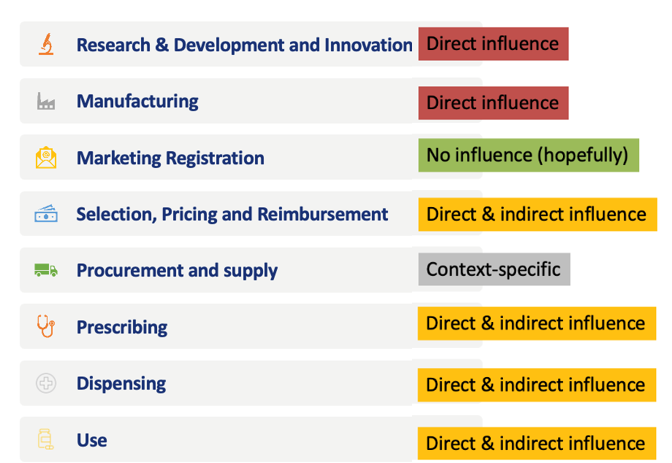
Equitable access to medicines is a global concern and is strongly influenced by various commercial factors. The example of insulin – discovered more than 100 years ago – clearly illustrates the persistence of barriers and can be used as a tracer medicine to analyse the impact of these barriers as well as the influence of the private sector at each stage of the medicine pathway. Drawing on the medicine lifecycle framework developed by the World Health Organizations (WHO, 2018), which covers the entire value chain, from Research and Development and innovation (R&D) to prescribing, dispensing and use of the product the Figure below shows where industry influence might be present (Figure 1).
Figure 1 : Adaptation of WHO schematic framework on understanding the life cycle of medicines (Beran et al., 2021)
Across the pathway presented in Figure 1, the influence of the private sector can be examined at different stages of the medicine lifecycle. The privatization of the results of public research is one of the main issues, as public institutions lack medicines manufacturing capacity and manufacturing of medicines is therefore fully dependent on the private sector. In the case of insulin production, it is mainly dominated by three major multinational companies: Eli Lilly in the United States, Novo Nordisk in Denmark, and Sanofi in France. Although other manufacturers have been identified, they face significant barriers to entering the market, whether due to regulatory barriers or the difficulty of competing with these three dominant players. Thus the market is defined according to commercial interest instead of global needs. Another key point is intellectual property, this is less the case for insulin as the therapeutic product was discovered in 1921 and therefore the molecule itself is off patent for many years, but an increase in patents is being seen on injection devices and technologies. This relates to a broader issue linked with innovation, which for medicines often tends to be associated with higher prices. This increase of costs is often matter of practice rather than being strictly related to intrinsic value of the product. However, it raises important questions whether these innovations are actually appropriate and accessible for populations and countries in need. For example, insulin has seen an evolution in the types of products available from animal (extracted from bovine and porcine pancreases), to human (with the use of genetic engineering), and now so-called analogue insulin (synthetic form of human insulin modified to alter its absorption, and duration of action, and mimic more closely physiological insulin in the human body) and each of these innovations has come at a higher cost and with a rapid withdrawal of the previous product (NCD Policy Lab, 2025).
Regarding regulatory processes, it is expected that the private sector’s influence remains limited as these functions primarily fall under the government’s responsibility to ensure safety and quality of medicines. As for medicine selection, price determination and reimbursement the private sector may hold direct and indirect influence especially in dictating the price of their medicines to health systems as well as “lobbying” activities to ensure their medicines are included in country’s reimbursement lists. The involvement of the private sector in procurement and distribution depends on the context as some countries rely on public systems while others depend largely on private actors. It is important to note that although in thinking about the commercial determinants of access to medicines the focus is often on “Big Pharma” the private sector in the medicines space can also include wholesalers, private distribution companies as well as private pharmacies. At the final level of prescribing, dispensing and use, the private sector can also have significant influence particularly on physicians, pharmacists and patients through a variety of means.
Price, Affordability & Shortages
Studies have shown large price variations, particularly for analogue insulin, across countries and governments impacting affordability for health systems and individuals (Ewen et al., 2019). The affordability of medicines as well as the accessibility is not only a low-and middle-income country issue. Studies analyzing the trends of medicine prices as well as the share of household’s income spent on medicines (Morolla et al., 2025; Guessous et al., 2012), highlight the financial barriers to access for European countries as well, including Switzerland. For example the prices of insulin in Switzerland remains significantly higher than in other European countries. The median price in a group of European countries for a given analogue insulin was €9.0 versus €15.6 in Switzerland (Morolla et al., 2025). Pricing of medicines raises ethical considerations with regards to profit margins and differential pricing practices, but also what roles governments should play both globally and nationally on medicine pricing.
In parallel the increasing frequency and impact of medicines shortages, including insulin and other essential medicines is worrisome. The issue of security of supply of medicines and health products became evident during the COVID-19 pandemic leading governments to adopt a series of measures including stockpiles of medicines, providing financial incentives to keep a stable market, and various procurement mechanisms in order to guarantee access to these products. Governments play a central role in improving the supply of therapeutic products and medical goods, and they should act on market concentration, shifting priorities from the private sector and products withdrawals.
Shortages and stockouts of insulin have been reported globally across geographies and income groups. A recent report developed by the NCD Policy Lab highlighted that shortages of insulin have been documented globally and more particularly “every single country in the North and South America continents have been affected by insulin shortages and stockouts regardless of their Gross Domestic Product, national demand, and presence of local insulin manufacturing capacities” (NCD Policy Lab, 2025). One of the main drivers of these shortages is a shift in market priorities with the introduction of new diabetes medicines that have shifted commercial interest of the main insulin manufacturers.
Balanced influence
The private sector, governments and civil society each have a critical role to play in achieving a balanced access to medicines. Professor Mintzberg from McGill University argues that society can be described as a three-legged stool, with each leg representing civil society, the private sector, and the government. (Mintzberg, 2015) He suggests that a stable society needs all three legs to be balanced. If one side gains or loses power relative to the others, the stool becomes unstable.
"What we see with the case of access to insulin and many medicines is that the private sector’s power remains unchecked by governments and civil society. What we see with the case of access to insulin and many medicines is that the private sector’s power remains unchecked by governments and civil society."
Marina Giachino/Sonia Bouhali/David Beran
However, as the example of insulin shows if access to medicines is simply left to market forces without strong government involvement and civil society engagement, access remains a challenge even though insulin was first used in an individual over 100 years ago.
References
Beran D, Lazo-Porras M, Mba CM, Mbanya JC. A global perspective on the issue of access to insulin. Diabetologia. 2021 May;64(5):954-962. doi: 10.1007/s00125-020-05375-2. Epub 2021 Jan 23. PMID: 33483763; PMCID: PMC8012321.
Guessous I, Gaspoz JM, Theler JM, Wolff H. High prevalence of forgoing healthcare for economic reasons in Switzerland: a population-based study in a region with universal health insurance coverage. Prev Med. 2012 Nov;55(5):521-7. doi: 10.1016/j.ypmed.2012.08.005. Epub 2012 Aug 23. PMID: 22940614.
Mintzberg, H. (2015). Rebalancing Society: Radical Renewal Beyond Left, Right, and Center (1st ed). Berrett-Koehler Publishers, Incorporated.
Morolla D, Beran D, Ewen M, et al. Role of biosimilar introduction on insulin glargine prices: a retrospective analysis in 28 European countries. BMJ Open 2025;15:e090484. doi:10.1136/ bmjopen-2024-090484
WHO (2018). WHO report on surveillance of antibiotic consumption: 2016-2018 early implementation. World Health Organization. 2018.
Marina Giachino: Project manager and PhD candidate at the Faculty of Medicine, University of Geneva, and the Geneva University Hospitals, within the Division of Tropical and Humanitarian Medicine.
Sonia
Bouhali:
Project associate at the Faculty of Medicine, University of Geneva within the
Division of Tropical and Humanitarian Medicine.
David Beran:Assistant Professor at the Faculty of Medicine, University of Geneva, and Geneva University Hospitals, within the Division of Tropical and Humanitarian Medicine.