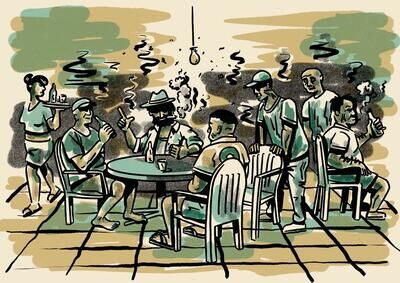
“To this day, I still feel traumatised when I talk about coffee. I feel traumatised because I immediately remember everything I experienced there.” These are the words of Jurandir dos Santos, a 50-year-old seasonal coffee picker from the state of Sergipe in north-east Brazil. Like tens of thousands of workers each year, he travelled south with his friend José Ademilson de Jesus Lima for the April 2023 coffee harvest. They had been promised fair pay and decent working conditions at the Mata Verde farm.
Instead, they faced exhausting workdays starting at 4 a.m. and lasting up to 12 hours, manually harvesting coffee on steep terrain and carrying 60-kilo bags in intense heat. Housing and sanitary conditions were degrading: leaking roofs, broken toilets, no proper showers, thin mattresses on the floor, rats, and contaminated drinking water. “We froze at night when it was windy… The drinking water tank, full of silt, was crawling with loads of beetles and other insects,” dos Santos recalled.
Food was largely insufficient for the heavy labour. Lima explained that many workers became ill with rashes, fungal infections and stomach aches. “One colleague was seriously ill for a week. We weren’t given any medication so we clubbed together to buy some for him,” he said.
Workers were paid per bag harvestedR$16 (US$2.90) per 60-kilo sack leaving earnings well below the statutory minimum wage. In addition, inflated costs for transport, food, protective gear and even water were deducted, leaving many workers almost without pay and pushing some into debt.
“No one leaves the farm”
According to Lima, armed guards closely monitored and harassed the workers. After he complained, he feared for his safety. When workers tried to leave, the owner threatened them: “No one is leaving the farm until their debts are paid off. If anyone tries, I’ll have the entrance to the village closed off.” Lima alerted the police, documenting the conditions on the farm.
Dos Santos, Lima and 12 other workers eventually escaped at night. Shortly afterwards, labour inspectors and police raided the farm and rescued the remaining workers. Inspectors identified 24 violations meeting Brazil’s legal definition of slavery-like conditions, including degrading working conditions and debt bondagethe restriction of freedom of movement due to debtsa form of forced labour prohibited under Convention 29 of the International Labour Organisation (ILO).
Mata Verde farm was added to Brazil’s “Dirty List” of employers using forced labour, and affected workers received very limited compensation of around US$800 each. Dos Santos and Lima later settled legal claims and obtained less than US$1,300 each.
A systemic issue
While the explicit threats of violence in the Mata Verde case were extraordinary, slavery-like conditions are widespread in Brazilian coffee cultivation. In 2023 alone, inspectors freed 316 workers from modern slavery on coffee farmsmore than in any other sector. The number of unreported cases is estimated to be very high, as labour inspections cover only around one in 1,000 Brazilian coffee farms each year. The fact that most workers are employed informally during the harvest season increases their vulnerability.
Worker organisations and scholars consider discrimination and abuse of seasonal labourers, many of whom are of African ancestry, by mostly white farm owners a structural problem rooted in the colonial period, when Brazil emerged as the world’s leading coffee producer. The country still holds this position today, accounting for around 40% of global production.
While some farm owners face public listing and moderate fines, criminal proceedings are extremely rare. Operators further up the supply chain face even fewer consequences: cooperatives, coffee traders, roasting companies such as Nestlé, and certifiers. This is partly because coffee supply chains are opaque, making it difficult to trace beans back to specific farms. Even when companies like Nestlé publish supplier lists, farms are excluded, so links to modern slavery only emerge through individual cases and extensive investigations. In addition, without due diligence laws in producer and consumer countries, holding companies legally accountable remains difficult.
"To ensure company promises are finally kept, rigorous controls and effective measures to prevent abuse and improve working conditions must be implemented in cooperation with local workers’ organisations. "
Carla Hoinkes
False promises
Nestlé has promised zero tolerance for modern slavery for years and claims that 100% of its Brazilian supply chain is certified. However, at the time of the modern slavery incident, the Mata Verde farm was certified by 4C, a standard used by Nestlé to demonstrate responsible sourcing. Following the labour inspection, the certification was revoked, but previous 4C audits had not uncovered any irregularities.
Despite Nestlé’s limited supply-chain transparency, we found that Mata Verde was not the only supplier linked to serious labour abuses in recent years. In July 2023, three workers were freed from slavery-like conditions at the farm Vista Alegre in the State of Minas Gerais that had sold coffee certified under Nespresso’s AAA sustainability programme. Only when confronted with our findings in 2025 did Nestlé react and suspend the supplier.
To ensure company promises are finally kept, rigorous controls and effective measures to prevent abuse and improve working conditions must be implemented in cooperation with local workers’ organisations. This includes promoting formal employment for harvest workers, ensuring they receive living wages, and guaranteeing a living-income price for coffee producers. While millions of coffee farmers and workers worldwide continue to face poverty and abuse, the business is highly profitable for large sellers: Nestlé alone generates well over a billion in profits from coffee each year.
Countries hosting coffee multinationals also have a responsibility: they should work to introduce human rights due diligence legislation to ensure that companies respect the rights of farmers and workers and are held accountable in cases of abuse.
This report is largely based on accounts given by Jurandir dos Santos and José Ademilson de Jesus Lima in March 2025. The full story, including Nestlé's response, is available at stories.publiceye.ch/modern-slavery-coffee.